

Interview with the Philippinan Authors Daryll Delgado and Kristian Cordero
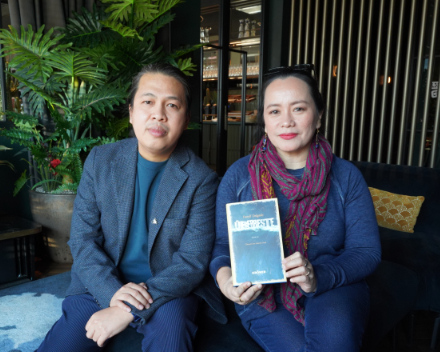
„We are all subjected to climate crisis“
Daryll Delgado: Hi, my name is Daryll Delgado. I am a writer from the Philippines. I’m here for a series of conversations, meetings, sessions about Philippine literature and to talk a little bit about my novel “Remains”, which was published also in German just this month. (Daryll Delgado: Überreste. Roman. Übersetzt von Gabriele Haefs. Kröner 2025, 300 Seiten)
Kristian Cordero: I’m Kristian Cordero. I’m also a writer and publisher from the Philippines. I’m here as part of this delegation from the Philippines composed of writers, editors, publishers in preparation for our being the guests of honor in the coming 2025 Frankfurter Buch Messe. I’m Darylls publisher. We published the book in 2019 and had it reprinted because it was widely received in the Philippines and so we had to do another edition.
Martin Zähringer: In which language is it written?
KC: It’s written in English, but I think what is unique about the novel is that it also has a special place for a local language in the Philippines, which is Daryl’s mother tongue. It’s called Waray, so you find the Waray and the English language coming together in this novel.
MZ: Let’s talk a little bit about Waray. What is its status in the Philippines?
DD: Yes, so Waray in my language literally means “nothing” or “none”. I’m not very sure about the origin of that name, but it refers to the language used by the people in the eastern Visayas region of the Philippines. So that’s somewhere in the middle part of the country facing the Pacific Ocean and it’s very much related to another big language group in the Philippines called Bisaya. So under the umbrella term Bisaya there are several other languages or language groups and Waray is one of them.
MZ: But you decided to write it in English, your debut novel. Why?
DD: Yes, because I write in English primarily. My first language is Waray because that is the language of the place where I grew up in. But I decided to write in English because I was educated fortunately or unfortunately in the English language and it was just a decision I suppose. And then when I wrote this novel, I thought of it as a novel in Waray but written in English. And it was important for me to acknowledge my limitations also as a Waray writer who cannot write in straight Waray.
So if you read the original version of the novel, the characters are freely speaking to each other in a combination of English, Tagalog, Waray, and other languages because that’s just how people speak to each other. I think especially people from a certain class, like the educated class. So I wanted that to be part of their characterization.
But you will also see in the novel that when the main character is talking to other people, like local people, there is an effort for her to speak in the local language purely. And that’s why the chapters of the novel are sometimes broken by transcriptions in the Waray language. Sorry, that sounds very complicated.
MZ: It sounds like Spanglish in American fiction, when some Spanish dialogues or so are intermingled in the English texts, with that difference, that you have code switching within languages from one country, the Philippines. Kristian, would you like to say sth about the language Bicol?
KC: Well, Bicol and Waray share the same geographical position, I would say. There’s a portion of our islands and Bicol Peninsula that faces the Pacific Ocean. So we’re the gateway of typhoons in the Philippines. We know it that when typhoon is about to hit Samar and Leyte, which is Daryl’s location, it would certainly hit Bicol as well. So Bicol is another ethnolinguistic group in the Philippines. We are 400 kilometers away from Manila. And within the region itself, there are sub-languages, meaning there are dialects in the region. As of the moment, there are four major Bicol language groups and 16 dialects of this language.
MZ: In which language do you work?
KC: I started writing in Filipino, the national language. And then towards the end, I discovered that there are other languages in the Philippines that I can also use. So I’m writing in Rinconada, which is my first language, and then Bicol Central, which is the language of the regional capital that is Naga. So it’s like a babble.
MZ: What are your language politics as editor of the Ateneo de Naga University Press?
KC: For the longest time, publication in the Philippines is centralized in Manila, controlled by the four major universities who would usually compete in the annual basketball tournament. But at the same time, these four major universities have their own respective publishing houses. So we decided to put up our own in Ateneo de Naga.
And part of our mission was not just to decentralize publishing in the Philippines, but at the same time to aid other regions, to bring other regions to our region, so as we create a new ecology for books. So it’s interesting that Waray and Bicol are very close to each other, but we hardly know each other because we always look at Manila as our point of reference. So in 2012, when we established the University Press, we made it a point that aside from doing translation, we were also publishing regional works, not just in Bicol, but also with other regional languages.
And this time, we’re doing it towards the south because it’s always been towards Manila. So we did publish books of poetry in Kinaraya, in Cebuano, in Waray, and other Visayan and Mindanao languages.
MZ: Daryll, I’m very interested in the ways writers today deal with climate issues. I think it is very interesting, that many debuts in these days deal with climate change or climate action. Your novel is about a typhoon in the city of Tacloban, Leyte. Why did you choose this subject for your debut?
DD: Yes, I did not originally set out to write a novel about the catastrophe or about the disaster. To be honest, I was writing a completely different novel, something I had been working on for many years. And then while I was writing that other novel, I kept getting stuck in certain images, certain parts of the plot and the narrative.
And there were, I guess, I realized I had other materials that I could set aside because they just did not belong anymore to this novel. And then when I looked at those materials, I realized that they actually form, could form something else. So when I realized what I had and I arrived at a structure, I felt free to write whatever I wanted.
MZ: Can a reader follow this process?
DD: It’s very interesting because if you read my novel, it’s not a completely linear or, you know, your typical well-structured novel. I think it’s very chaotic, but it’s by design. And when I realized that this is the only way I can write this novel, then the writing went very fast. And I realized that for a long time, I did not want to write about the typhoon. I did not want to write about the disaster because I felt that wasn’t the response that was needed at the time. The response needed was to be on the ground, to talk to people, talk to government officials, you know, help where you can.
MZ: That means we have a real background, Super Typhoon Yolanda in 2013, also known as Typhoon Haiyan, which killed at least 6.300 People alone in the Philippine region Visayas. How did you get into the process of writing about that disaster?
DD: Nobody was looking for a novel or a book about their experience, right? So that’s why I was also hesitant because I did not want to exploit and take advantage of people’s feelings and people’s experiences. So it took a while and I had to work through my own politics and my own reservations about the subject. And then finally, I felt comfortable because I realized I wasn’t just writing about the super typhoon.
MZ: The Philippines are historically known as a typhoon region. So was it just a normal issue for you to write about that phenomenon?
DD: I wasn’t just writing about, you know, environmental disasters. I was finally starting to talk about how these disasters are not natural. They’re man-made and you cannot look at them outside of, for example, history or outside of the political frame and outside of culture and even spiritual experiences of people. And so yeah, then I became comfortable to write about it when I realized that it’s more complex and it speaks to so many other concerns that I care about.
MZ: What was the most challenging part in this writing?
DD: The most challenging part was being true to the reality, being true to the experience, but also being very deliberate because it is a work of fiction. You know, it’s literature, it’s a novel, and I could have written a maybe a creative non-fiction piece or an investigative journalism piece, but I chose to write a novel and that decision was very deliberate. So in writing a novel that deals with a very real experience, even if you’re dealing with fiction, my belief is that you still need to be very true to people’s experience. It needs to ring true for people who will read it and, you know, people who know about that. So that was difficult because I wanted it to read like a novel but I also wanted it to feel hyper real, you know. So I don’t know if that makes sense to you.
MZ: Of course, makes a lot of sense. From my perspective, it’s just the exiting point in writing about climate catastrophes. Not long ago such supernormal phenomenons were sujet of dystopian fiction, speculative fiction, climate fiction, but not only this. We also find a long tradition of realistic writing about the floods in Loisiana/US, drama, novel, poetry, three poetry books alone written by single writers about hurricane Katrina in 2005. It’s part of the larger Black American Literature, because black and poor people mostly were the victims and the writers on these floodings. Manmade some of them, of course.
And my question now to you, Kristian: What kind of tradition has been generated by catastrophes and climate change in the Philippine literature?
KC: I’d like to think that the earliest poem in Tagalog is actually about a typhoon and a great flood. So even our oral literatures talk about volcanic eruption, these tropical typhoons that are part of the landscape, the experience of the people. But I’m very interested with this idea of climate writing and putting this as some kind of a category, I think will give people the chance to discern that climate is not just a romantic way of looking at nature, but there are political realities that have to be considered in terms of talking about climate.
MZ: What kind of political realities in the Philippines?
KC: I remember in particular, the way weather reports are being made, it would still constitute some confusion among people, because mostly it would be done in English or it would be done in a language that is not accessible to people. So I think writers, creatives have special roles in this kind of messaging, in this kind of relating this important matter, because after all, we are all under the same sky. And I’m glad that Daryll has taken the courage to write a novel that is now incarnated in the German language, and this ensures that the conversation will go on.
MZ: We’ll come back to Darylls novel. What about Philippinian trends in environmental writing?
KC: I’d like to cite other writers from the Philippines, and interestingly, most of them are women who are writing about disasters and the experience of this fragile earth. Merlie Alunan, the poet, from the same region, writes poetry and when she writes her poetry, it’s not just about the ecological disaster, but the historical, the political malaise that have been plaguing the land. I’d also like to cite Dinah Roma, who wrote a poetics on her experience during the Supertyphoon Yolanda .
And then from our region, the writer is Merlinda Bobis, who is based in Australia, but has been writing about the environment, about the birds, the fish hair woman, the volcano in the Bicol region. So there is a catalogue of writers from the Philippines, most of them are women who try to conjure a world where we can really talk about this matter as something urgent and necessary. Yes.
MZ: Daryll, would you say some words about indigenous perspectives in your novel?
DD: Yeah, so I mean, I am by no means an expert in indigenous cultures, although as part of the work that I do for a human rights and a labor rights NGO, we do work a lot with indigenous communities, indigenous peoples, and so on. And in my novel, because it’s set in the late summer region, there is a reference to something that happened almost exactly 100 years ago. And that event, it was a cataclysmic event, and they had a word for it, Dunot, devastation. And even I, you know, when I was growing up, that word was always familiar to me. I would hear people talking about it.
And I realized while I was working on the novel that it has become part of oral tradition, oral narrative. And when you talk to people, like older people, they still have a memory of what their, for example, their parents or their grandparents told them about the Dunot or about the catastrophe and what the signs are. And it was so interesting to listen to that.
MZ: Why do you think using elements of oral history is so important for environmental writing?
DD: Because again, this speaks to what Kristian was saying earlier, that people have a different experience and understanding of and a relationship with nature. And when you speak to them using Western scientific or technical language to give them a warning about what’s going to happen, they probably won’t understand that. But if you use their language, you use descriptive language, you use narrative, then they would have understood very clearly and they would have said, this is exactly what we were warned about more than 100 years ago, because they knew that it was going to happen again. So like more than 100 years ago, this happened to their town. And they were told that this will happen again, unless, you know, certain changes are made. So that is as far as my knowledge of indigenous like culture goes in relation to how they deal with climate in this novel in particular.
MZ: Do you have further reations to this part of Philippine culture?
DD: I mean, of course, I can talk about indigenous culture and indigenous knowledge in relation to my other work, which has nothing to do with the novel. Okay, if you’re if you insist. So one of one of the things that I personally am involved with in my organization is, for example, the palm oil commodity, if you’re familiar, so palm oil.
Yeah, so my organization is called “Dignity and Work for All”. So that’s a global labor rights organization. So one of the things we look at are the working conditions of that are related to the production of some of the most like popular or common commodities. And one of these is palm oil, because it’s in everything that we consume, you know, and this oil is produced in Southeast Asia, largely. Malaysia is one of the biggest producers of this palm oil. And the biggest production region is in Sabah, which borders the southern part of the Philippines.
And if you go there, you will see that the workers, the field workers are mainly Filipinos or Indonesians, who have been crossing back and forth these very porous borders without documentation, you know, because they have no notion of borders, right? And they themselves come from their own indigenous communities, and they bring their indigenous culture, their indigenous knowledge to the plantations. And if you talk to them, they know what is good, what is good agriculture.
MZ: The palm oil industries is definetly not good agriculture.
DD: Well, but when they say good agriculture, it means good for the soil, good for the planet, good for the environment, good for people. But of course, when the big companies started coming in and organizing them into, you know, industrial plantations, then things changed. And that’s when, you know, disasters started happening, like, you know, use of pesticides, insecticides, and then so on, and exploitation of labor.
So this has a lot to do with, you cannot talk about that issue without talking about migration, without talking about indigenous culture, and without talking about women. Because the migrant women in these plantations are typically not employed in a formal manner. So for example, if I go there as a family, it’s only the men who will be employed on paper, they will be paid, but it’s the whole family that works.
Women are erased, they basically, you know, are invisible, they don’t exist. But their labor is very significant, and their knowledge is very significant. So yeah, so that’s how I get into topics of, like, gender, and indigenous culture, and you know, all of that.
MZ: Wouldn’t these experiences be good stuff for short eco stories?
DD: For some reason, I have not written fiction about that work. Because I don’t know, maybe I want to keep that work kind of sacred. Because maybe fiction is not the best approach, it’s not the best use of my skills. If I have, you know, if I have data, and if I have access to people giving me their stories, their information, my decision has got to be more, like, practical and more urgent. Maybe for this type of issue, fiction, that’s just my feeling now, fiction is not the solution. I’m not discounting the possibility of writing about that whole, you know, issue within a novel, eventually. In fact, I have been working on a project that kind of touches on that.
Martin Zähringer: As far as I know there is a great number of Filipinos in the US, but also in Honkong. What means diasporic writing for climate writing in the Philippine literature?
Kristian Cordero: I’m not sure about the Diaspora, but I know in particular about this school of thought that is called the Ecocriticism. There has been some important changes in the way we teach literature. For the longest time, we think of literature in terms of its historical development, and this historical development is framed within the Spanish-American, the World War II, and then the post-Marcos years, and then the post-EDSA literature, and so on and so forth.
But I think it’s important that when we talk about ecocriticism, we’re not just thinking of nature, but we also have to deal with the political and historical realities. For instance, in one of my works, which I did recently, it’s a documentary on the indigenous people in Buhi. They had this terrible landslide in 2018, and as part of their response to the terrible experience, which destroyed their community, some of the men were asked by the parish priest to do some debriefing and art workshop, and they gathered all this forest debris that they found from the ground zero and turned this into some sculptural pieces.
And during the filming of this documentary, I was particularly struck by the fact that when we were interviewing the elders of the communities, they were referring to a certain kind of the indigenous people called Cimarrones. These are the people who are not Agta. They are not pure Agta because according to one of our respondents, the Spanish took advantage of the indigenous women and would rape them. And as a result, the children of these women are called Cimarrones.
Daryll Delagdo: Cimarron means forest, right?
KC: Yeah, and mountain people. So my thought on this is that the historical trauma is still evident, still present. And at times when we teach literature, when we teach arts, we tend to forget that when we look into the particular period as to how this art is formed or as to how this issue is being talked about, we forget that there’s a long history that happened while we are in this kind of environmental crisis.
So I think that’s the direction I would like to see, that when we talk about eco-criticism, we do not romanticize nature. Instead, we think of it as a site of power struggle. But at the same time, it’s also the site of stories about intimacy, about devotion, about this kind of relationship that puts man in this kind of relationship with nature.
DD: And it’s fragile. It’s fragile. It’s terrible.
KC: It’s almost like sublime. And I think the Indigenous people, in my experience in doing that film, have taught me a lot in terms of referencing, acknowledging traumas upon traumas upon traumas. I think there will be a special section as part of the participation in the Frankfurter Buchmesse. I know in particular, even the filmmaker Lav Diaz has several films on typhoons and drought. Brillante Mendoza, who won a Best Director trophy from Cannes, has a film on Yolanda, on Taklub.
So I think it’s important that when we think of literature, we also think of other creative productions in cinema, in visual arts, in performances. We have to see that all these art forms are living under a particular ecology. And the challenge for us creatives is to find the connections to our works.
MZ: In Heidelberg there is an art exhibition called “The Oculus” as part of the Gastland Event in Frankfurt. I read they show a work about a group of Filipinos who believe that José Rizal is the born again Jesus Christ of the Philippines. What do you think about such kind of religious adaption?
KC: There are certain groups in the country that regard Rizal as the messiah, and Mount Banahaw as the new Jerusalem. Reynaldo Leto, a Filipino scholar, has written an extensive study on this millenarian movement. My take on this would come from something like, I do not subscribe to the faith system. I see the danger of any cultic groups. There’s always that danger. But I’d like to particularly point out that in this group, I think we can learn how, for instance, they regard Mount Banahaw as the new Jerusalem. I’d like that, you know, that mountains are religious sites. And I think of that as a response to colonialism, to Catholicism. Because when Catholicism came, they asked us to move down to our poblacion, to our cabeceras, to the new centers. And we have forgotten our relationship with the mountains, with the caves, with the rivers. And all of a sudden, we were inside the church. And I think of that as, you know, there’s this struggle, and I respect them for, you know, thinking of this kind of connection.
MZ: The roots of a new Jerusalem in pagan traditions, sounds interesting. Are there other religious or mythical adaptions of José Rizal as a person? (I have to add here that José Rizal is the main character in Philippine literature and, as a writer is to be traced as literary hero, also at Frankfurt Bookfair.)
KC: Aside from this group, the Rizalistas, we have the Philippine Independent Church in the Philippines, who think of Rizal not as a messiah, but as a saint. And so as with all other heroes. So this thematic church was established at the early start of the 20th century. And this is the only residue of the great Philippine Revolution of 1896. So the Philippines is a very interesting country.
We have, you know, in our history, we had popes who declared themselves free from the European, from the Roman Catholic dominion. And when you think of history this way, you have to respect that kind of history from below. And most of these people who are seen as those who are below us are actually the indigenous, the poor, the marginalized. So those voices are valid and important.
MZ: Are there any efforts to support them?
KC: It should be. There are so many media now. It’s not just the written form. With the available technology, we can actually do and encourage more young people, scholars to go into the peripheries and listen from them, learn from them. It’s not always us doing, you know. I think that’s the reservation of Daryll when you turn their stories into fiction. You also have to navigate around ethical issues. And I think we are very much aware also of those issues. And we cannot just tread on that dangerous area.
MZ: Which books by Josè Rizal are beeing translated to German?
KC: There is El Filibusterismo and then Noli me tangere will have a new edition, an updated edition. But we’re still hoping that beyond Frankfurt, we will have to continue what we have started here. And we still have this legacy project that we wish to materialize. And that is translating Rizal from Spanish to German. And we’re now in contact with the one who translated Don Quixote from Spanish to German to do the same thing to our national hero. I think it’s a good point.
It’s a good time to do this conversation. And we thank you for helping us articulate these narratives, these voices from the Philippines.
MZ: Its a pleasure for me. Daryll, what has José Rizal been for your literary identity?
DD: Oh, for me, personally? I think it’s a valid question. It’s still an important question. There was a time when I was in college when the fashion or the cool thing to do was to dismiss Rizal. To say that, oh, he’s unimportant. But I think there has also been an effort to sort of rescue him from that kind of thinking. And coming to Berlin when I decided to join the delegation, I decided to reread Noli me tangere, and to listen to the audiobook. And it was so moving, honestly. And I don’t know if it’s because of the times that we are living in, but the description of the power struggle, the description of exploitation, and, I mean, not to be dramatic about it, but listening to the audiobook and reading made me realize how little has changed. And how disappointed Rizal and the revolutionaries would probably be to know this.
And also how international and how universal, I don’t want to use the word universal, but how global and how relevant the work is in relation to, for example, what’s happening in Palestine, what’s happening in the Philippines, what’s happening in other countries, what’s happening in America. The description of exploitation is the same. So exploitation from a hundred years ago and exploitation now, it’s basically the same.
MZ: So you have different experiences with this writer?
DD: How I feel about the book now and how I feel about Rizal is almost completely different from how I felt about him when I was in school. Because in school we had no choice but to study him. We had no choice but to memorize chapters, convert some of the scenes into plays, create songs about him. And that was fun, but maybe that was not the best way, or maybe that was not the only way that the book and this writer, this national hero could have been taught.
MZ: Why?
DD: He was designated. He was appointed. I think Rizal is first among many of our national heroes. We have, right now we have, we can import our politicians if only the world will accept them. Because we have so many politicians. But I’d like to be reminded that there was a time when we were producing people like Rizal, and there’s a generation of him in the Philippines. It was a turning point in that period when the world was changing and they had also to usher this little colony in the tropics to a new kind of beginning. And Rizal was at the threshold of these changes. And yeah, he was an educated man.
KC: I think he had problems with sleeping. He don’t sleep a lot. He didn’t sleep a lot.
DD: How could he have done all of those things that he did?
KC: He probably did not sleep at all.
DD: Yeah, I have that feeling as well. Like when you read his life story, the way, I wish he had some good sleep when he was doing all these things. But yeah, he is one of our national heroes. And it’s good that the public may also know other Filipino intellectuals of this particular period. And he’s always put together with another guy named Andres Bonifacio. Rizal holds the pen, Bonifacio holds the pistol or the bolo, as we were told.
KC: But both of them were writers. Bonifacio wrote poetry. He wrote songs. And I think it was just part of the way they expressed their revolutionary sentiments. And we forget that there were other artists, hero figures during that period because so much focus is on Rizal.
MZ: I could not find Bonifacio in the list of translations. Would you name some other important writers from the Philippines?
BC: We will work that out. We can cite names. And at this point, we haven’t really done much research on the women, on the mothers. And Ambeth Ocampo, this public historian in the Philippines, would always highlight the fact that when they were leading the revolution or when they were creating this chaos, they were young men, not yet in their 30s. Rizal was in his 20s, maybe 27, when he finished NOLI. Bonifacio, as Daryll said, was a poet.
DD: The pen name of Bonifacio is May Pag-asa – There is hope. And I think there’s something poetic there. An irony, if I may call it as such. That the one who led the revolution wanted to be called as someone who holds hope, May Pag-asa.
KC: Leona Florentino. That one, the Ilocano?
DD: Yeah, the Ilocana, a female revolutionary poet who wrote so many poems. And gave birth to Isabella de los Reyes.
KC: Isabella de los Reyes is another historical figure who established the Philippine Independent Church. The Philippine Independent Church, basically the revolutionary church. And then the First Labor Party. Yes, the First Labor Party. So there are just so many historical figures that, I mean, we cannot run out of these historical figures as well. But sadly, our media would tend to focus only to one side about the Philippines. It’s not fair. In the same way that it’s not fair to limit Germany to one particular historical figure, right?
MZ: Which sphere is it where the unfair focus is?
KC: Well, you know, we’re in a current situation right now where a former president was being tried. So yeah, I mean, the will of justice takes its course. But it’s not just the Philippines. We’re just too varied, too complex.
MZ: Let’s talk about Catholicism. The Spanish colonizers have been here for 300 years and they brought Catholicism, which is the main religion in the Philippines. But the Spanish language is nearly insignificant. Why?
KC: Catholicism is very entrenched in Philippine life, but we did not get the language. Yeah, because it was deliberate for the Spanish missionaries. They learned a lesson in South America. So when they came to the Philippines, to that part of the world, they saw us as babies, babies of faith. So they had to take care of us and instead of introducing their language, they studied our language, preserved it through their colonial apparatuses like the printing press, the dictionaries that they built. I have a strong feeling that the Bicol of Naga is a Catholic invention.
It’s an invention of the Catholic Church. While the languages in the peripheries are the languages that have survived from that wreckage. And I like the fact that we are multilingual because if there’s a particular language that keeps insisting on itself, it keeps insisting its own kind of history. And that’s very important. So in the Philippines, you have all these languages. They say that the longest bridge is in the Philippines because the word for an egg here on this side of the bridge, when you cross, that same word becomes the bird.
MZ: Can you say something about translating Rilke?
KC: Well, I did translate it from English. From English, not from Deutsch, my German is as bad as a beer with an ice. Yeah, I did translate Rilke and Kafka. I first tried my hands on Rilke the first time I visited Germany in 2009. I was so impressed with the country. I find this, because of Rizal, I was doing some sort of drama. I was breathing the air that Rizal experienced. So I discovered Rilke and then I did Rilke in Bicol. Because he was to me a very spiritual poet. I wanted to charge Bicol with a new kind of spirituality that is not Catholicism, but at the same time, Catholicism. Because I would use the same vocabularies found in the lexicon of the Catholic Bicol and induct it to a new kind of poetry that is more like who can be arrogant to a god, to an idea of a god. So I think I saw it in Rilke.
MZ: You also translated Franz Kafka, please say some words about translating him.
KC: In the case of Kafka, everyone likes metamorphosis. I was particularly struck by that point when Gregor Samsa started talking in a gibberish language, which the immediate family could not understand. So when I was doing my translation, I made Samsa speak another language, which is Rinconada. So there was a certain kind of experimentation there. You don’t see that in the other translations of Kafka, nor in the text of Kafka itself. It’s just German. But here, you get to play around the text, that instead of using the main language structure, you use another language, which is Rinconada.
MZ: Und was kommt dabei heraus?
KC: Nowhere in our history where you will have to see the Rinconada and the Bicol Central in one book. It’s in the same manner here. The Waray and the English coexist. They coalesce. So I think that’s the metamorphosis. That’s the change that I want to create within my language.
MZ: Would you say something more about your novel and writing about that?
DD: Yeah, I mean, that’s not easy to do. I have not really gone out to do, say, a survey of what other novels are out there to which my novel could be categorized under. When I read novels, for instance, I see here and there certain resonances, and I find myself drawn to certain novels compared to others. I realize one of the things that draw me to these novels is the novel’s relationship with nature. I’ve just become more conscious about that.
MZ: Would you consider yourself as part of a global Climate Fiction scene?
DD: If there is a body of literature out there that looks at nature, looks at climate, in the way that I wish it would be looked at, then I would definitely want to be a part of that movement. I want to contribute to that movement. I want to contribute to the expansion of people’s understanding, not only about climate but also about novels and the role or the function or the importance of novels during these times. I would love to know more about other people who are doing the same thing.
KC: See you in Frankfurt in 2025. We hope that there will be more Filipino writers to get the chance to be translated in German and other languages. It’s high time that we open this possibility and turn it into something that we can hold on as some little act or some kind of a grace that we can hold on as we proceed to maybe a more turbulent years.
DD: Something more from your side? I want to know who are your audience, who are your listeners in your program typically?
MZ: Typically, it is the public radio in Germany.
DD: So it’s part of a network?
MZ: Yes, it’s the ARD network of the public radio in Germany. We have lots of stations. In Berlin, we have the Deutschlandradio Kultur and another station from Deutschlandfunk is Köln, they braodcasting also nationwide. So I write also for newspapers which is a little bit hard at the moment because of a shrinking market.
DD: So it’s a very wide audience.
MZ: Yes, it should be. But mostly in German. On my website and at Linkedin I have published some English texts.
DD: The only reason I’m asking is maybe I want to address whoever, the audience that you’re creating these materials for, and if it’s primarily a German audience. So I think I’m very appreciative of the fact that there is an openness to listening, to learning about other people’s experiences and other countries‘ experiences of the world.
We are all subjected to climate crisis, to climate change, to economic downturns. And I think after the pandemic, I don’t think anyone will argue that we are all connected. What happened in one little town in Italy was very similar to something that happened to a town in Bicol. We are all connected. And I think that’s what I hope people will continue to feel about each other, about us. And one of the ways that can cement that connection is really books and translation.
And translation can never 100% bring the experience or the story across to the other side because translation also has its own limits. But I think people should not be afraid to hear new words and to listen to new voices. And I think people should not be afraid to try to go out of their usual frames of thinking, usual ways of looking at the world.